Learn each poem, practise its language and techniques, explore deeper meanings and themes, discriminate between weak and strong model answers, then produce and self-check HSC-style responses.
How to use this lab
Each poem follows the same learning cycle so revision becomes predictable but not repetitive.
1 Synopsis & literal meaning
2 Vocabulary & language choice
3 Technique & effect
4 Themes & deeper meaning
5 Model-answer discrimination
6 Guided response
7 Independent response
8 Self-mark & revision priority
HSC habit
Move from what the poem says to how Hughes says it to what this reveals about culture and identity.
Technique toolkit
Extended metaphor
A comparison develops across the poem.
Repetition
Creates insistence, rhythm or emphasis.
Vernacular / dialect
Represents culturally grounded voice.
Rhythm / blues form
Connects poetry to Black musical traditions.
Symbolism
An image carries wider cultural meaning.
Juxtaposition
Contrasts expose tension or inequality.
First-person voice
Claims authority over experience.
Allusion
References history or culture to deepen meaning.
Choose the best analysis
Poem 1
The Negro Speaks of Rivers
Interpretive artwork · a discussion prompt, not historical evidence or a literal reconstruction.
Meaning in brief
The speaker connects identity with rivers associated with ancient civilisations and Black history. The movement across time develops cultural continuity.
Look closely: Layered rivers and light suggest depth and continuity. The image combines places symbolically; it does not show one real journey.
Image → poem → analysis
Question: How does the river image connect an individual voice with collective history?
Compare a B2 analytical model
The rivers give the speaker’s identity a depth that extends beyond one lifetime. By bringing distant places and periods into one voice, Hughes challenges the idea that Black identity is recent or culturally marginal. The image is useful as a prompt for this connection, but the claim must be supported by the poem’s actual river references and repeated language.
Evidence hunt: Find a brief phrase connecting physical river depth with the speaker’s inner life. Explain the relationship rather than treating “deep” as only a description.
Check exact wording in your authorised copy. Explain a choice in the poem; colours and objects in this illustration are not Hughes’s techniques.
ancestryhistorycultural memoryresilience
Synopsis
The speaker links himself to ancient rivers associated with major civilisations and Black history. The rivers become more than places: they symbolise continuity, memory and the depth of Black identity. The poem moves from individual voice to collective historical consciousness.
1. Literal meaning check
2. Vocabulary & language choice
Short evidence bank
“I’ve known rivers”“My soul has grown deep”Euphrates / Congo / Nile / Mississippi
3. Technique → effect
4. Deeper meaning
5. Theme priority
6. Write your own synopsis
7. Choose the best answer
Question: How does Hughes use the rivers to represent cultural identity?
8. Guided paragraph
9. Independent response
How does Hughes represent the importance of cultural memory in the poem?
Poem 2
Mother to Son
Interpretive artwork · a discussion prompt, not historical evidence or a literal reconstruction.
Meaning in brief
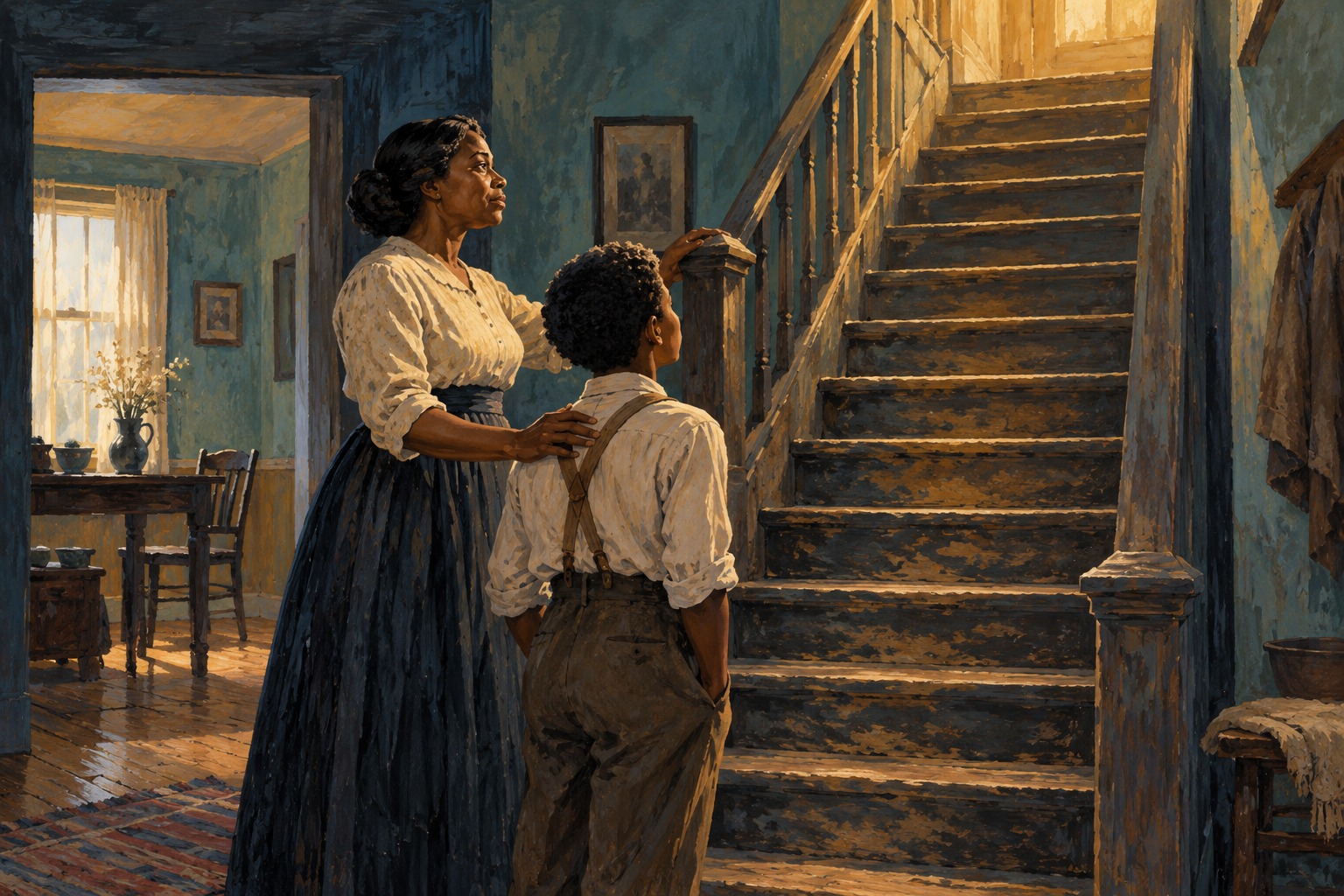
A mother describes hardship through an extended staircase metaphor and urges her son to keep going. Her advice presents persistence as an ongoing action.
Look closely: Notice the worn staircase and the relationship between the figures. Neither is a verified portrait of the poem’s speaker.
Image → poem → analysis
Question: Why is a difficult staircase more effective than simply saying “life is hard”?
Compare a B2 analytical model
The extended staircase metaphor gives hardship a physical shape, allowing the reader to imagine difficult movement rather than receive an abstract statement. The mother’s direct address also makes resilience relational: experience becomes advice offered to another person. A developed reading explains how vernacular voice and the continuing climb create authority without suggesting that determination removes every barrier.
Evidence hunt: Choose one obstacle in the staircase description. Explain its literal meaning, its figurative meaning and its contribution to the mother’s advice.
Check exact wording in your authorised copy. Explain a choice in the poem; colours and objects in this illustration are not Hughes’s techniques.
resiliencefamilyintergenerational wisdomhardship
Synopsis
A mother advises her son to keep moving forward despite hardship. She compares life to a difficult staircase and uses her own lived experience as proof that perseverance matters. Her voice turns personal struggle into intergenerational cultural wisdom.
1. Literal meaning
2. Language choice
Short evidence bank
“ain’t been no crystal stair”“tacks” / “splinters”“still climbin’”
3. Technique
4. Vernacular voice
5. Deeper meaning
6. Synopsis writing
7. Best answer bank
Question: How does Hughes represent resilience?
8. Independent response
How does the mother's voice communicate resilience and cultural wisdom?
Poem 3
I, Too
Interpretive artwork · a discussion prompt, not historical evidence or a literal reconstruction.
Meaning in brief
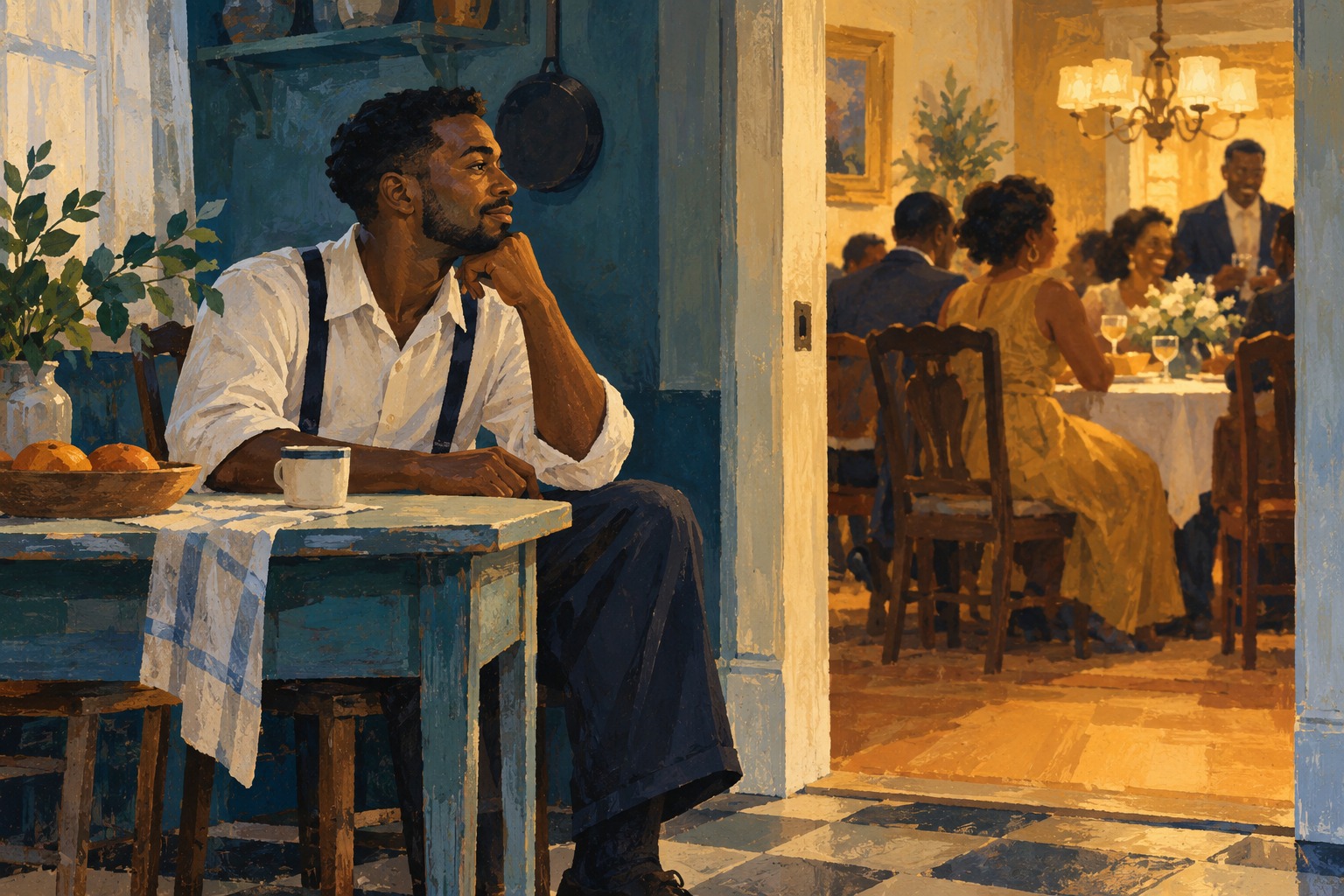
The speaker describes exclusion from a shared space and anticipates a future in which his belonging will be recognised. His voice resists the identity others impose.
Look closely: Compare the kitchen, doorway and dining space. They visualise exclusion and possible recognition, not a documentary scene.
Image → poem → analysis
Question: How can a domestic space represent a wider cultural boundary?
Compare a B2 analytical model
The separation of kitchen and table turns an everyday arrangement into a model of unequal belonging. The speaker’s anticipated movement into the shared space challenges that boundary, while his confident voice claims an identity that exclusion cannot erase. The poem therefore presents resistance through both spatial contrast and self-definition; it does not need to portray belonging as permission granted by others.
Evidence hunt: Find brief wording that contrasts present exclusion with future recognition. Identify how tense or voice supports the change.
Check exact wording in your authorised copy. Explain a choice in the poem; colours and objects in this illustration are not Hughes’s techniques.
equalitybelongingracial identityhope
Synopsis
A Black speaker describes being excluded but confidently imagines a future in which that exclusion ends. Domestic spaces such as the kitchen and table become symbols of racial separation and national inclusion. The poem transforms an individual voice into a claim to American identity.
1. Literal meaning
Short evidence bank
“I, too”“eat in the kitchen”“at the table”“I, too, am America”
2. Spatial symbolism
3. Repetition & voice
4. Deeper meaning
5. Synopsis writing
6. Best answer bank
Question: How does Hughes represent belonging?
7. Independent response
How does Hughes transform personal exclusion into a wider claim about American identity?
Poem 4
The Weary Blues
Interpretive artwork · a discussion prompt, not historical evidence or a literal reconstruction.
Meaning in brief
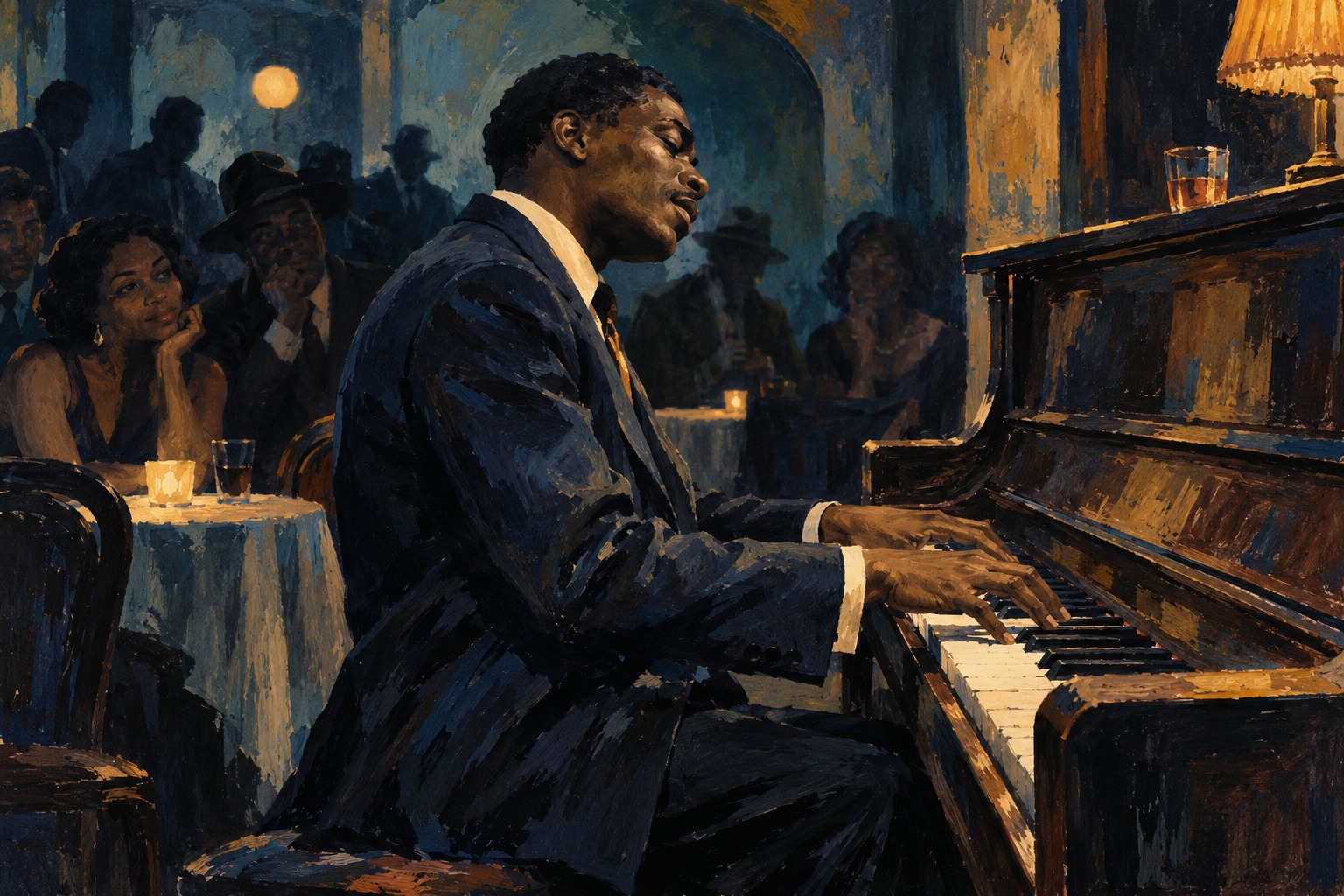
A speaker observes a blues musician whose performance expresses both suffering and creative power. The poem connects sound, feeling and cultural form.
Look closely: Observe the pianist, light and audience space. The imagined club supports discussion of performance; only the poem establishes its sounds and actions.
Image → poem → analysis
Question: How might rhythm communicate what a plot summary cannot?
Compare a B2 analytical model
Hughes makes blues performance part of the poem’s form, connecting cultural identity to rhythm and voice as well as to subject matter. The musician’s performance gives suffering an expressive shape, yet the atmosphere of weariness prevents art from becoming an uncomplicated cure. A strong response explains how repetition, musical movement and the relationship between observer and performer sustain this tension.
Evidence hunt: Find a short repeated or rhythmically distinctive phrase. Read it aloud and explain what its sound adds to its meaning.
Check exact wording in your authorised copy. Explain a choice in the poem; colours and objects in this illustration are not Hughes’s techniques.
musicsorrowBlack cultural expressionisolation
Synopsis
The poem observes a blues performer whose music expresses exhaustion and sorrow. Hughes makes the poem itself echo blues rhythms, combining poetry and music. Private pain is transformed into public cultural expression, showing art as both a record of suffering and a means of endurance.
1. Literal meaning
2. Why blues form?
3. Deeper meaning
4. Synopsis writing
5. Best answer
Question: How does poetic form deepen meaning?
6. Independent response
How does Hughes use musical form to represent Black cultural experience?
Poem 5
Madam and the Phone Bill
Interpretive artwork · a discussion prompt, not historical evidence or a literal reconstruction.
Meaning in brief
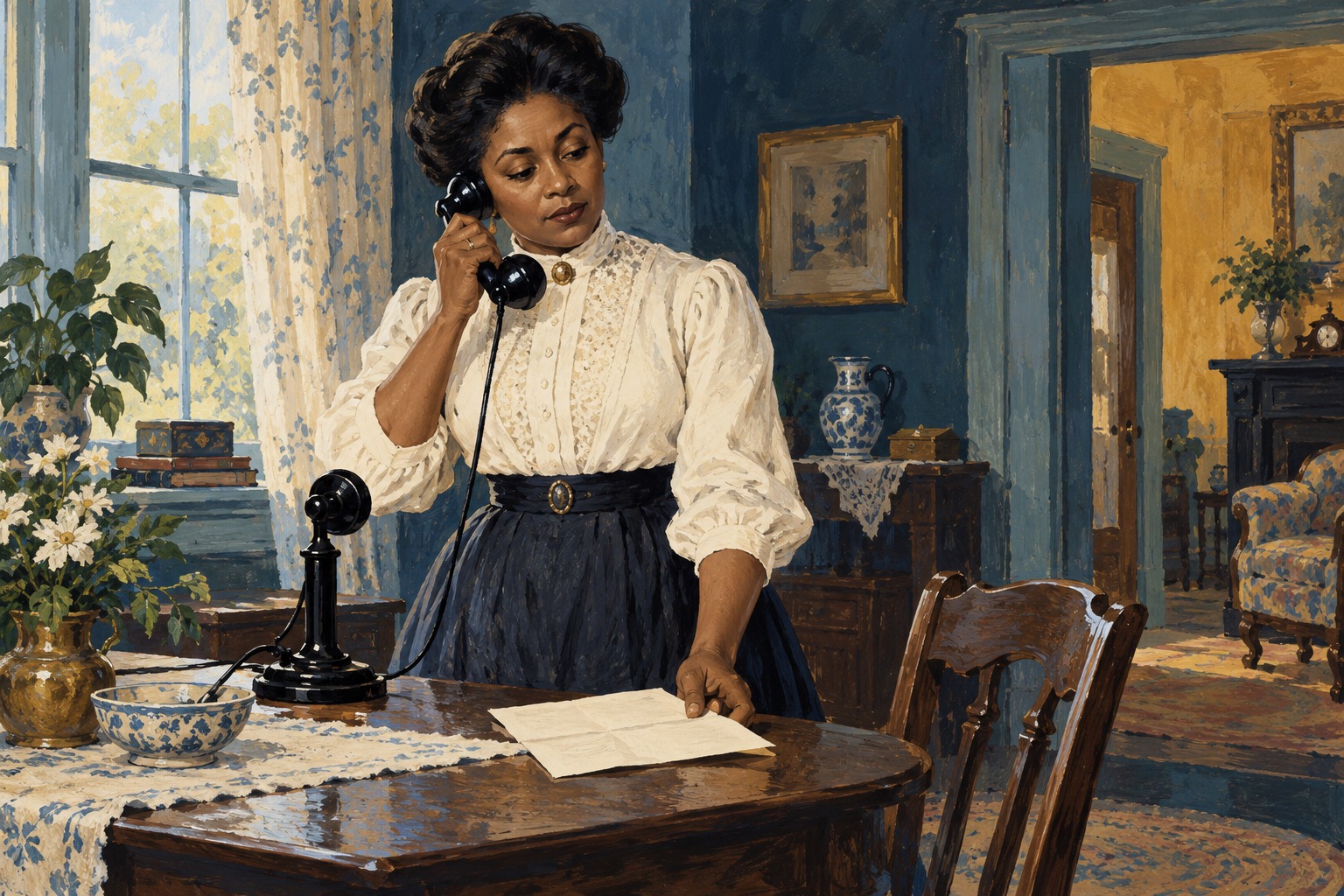
The speaker challenges a telephone bill and questions the company’s expectations. Everyday conversation becomes a site of authority, money and resistance.
Look closely: Compare the woman’s posture with the phone and bill. The objects prompt discussion of who can demand payment and who can question it.
Image → poem → analysis
Question: How can conversational language express power rather than a lack of sophistication?
Compare a B2 analytical model
Hughes gives the speaker authority through direct, conversational questioning. Her encounter with the telephone company makes an ordinary transaction a negotiation over fairness and whose explanation counts. The vernacular voice contributes to character and cultural presence; analysing it as merely “incorrect English” would miss how the poem uses speech to resist institutional assumptions.
Evidence hunt: Select a brief question or reply. Explain how its tone, syntax or directness challenges the other speaker’s position.
Check exact wording in your authorised copy. Explain a choice in the poem; colours and objects in this illustration are not Hughes’s techniques.
voiceindependenceclasshumour
Synopsis
Madam disputes a telephone bill connected to a failed relationship. Her direct, comic, vernacular voice allows her to challenge both financial pressure and the man who has left her. Hughes creates a speaker who is humorous but also assertive, self-aware and unwilling to be exploited.
1. Literal meaning
2. Voice
3. Humour & deeper meaning
4. Synopsis writing
5. Best answer
Question: How does Hughes use voice to represent independence?
6. Independent response
How does Hughes use humour and voice to represent independence?
Poem 6
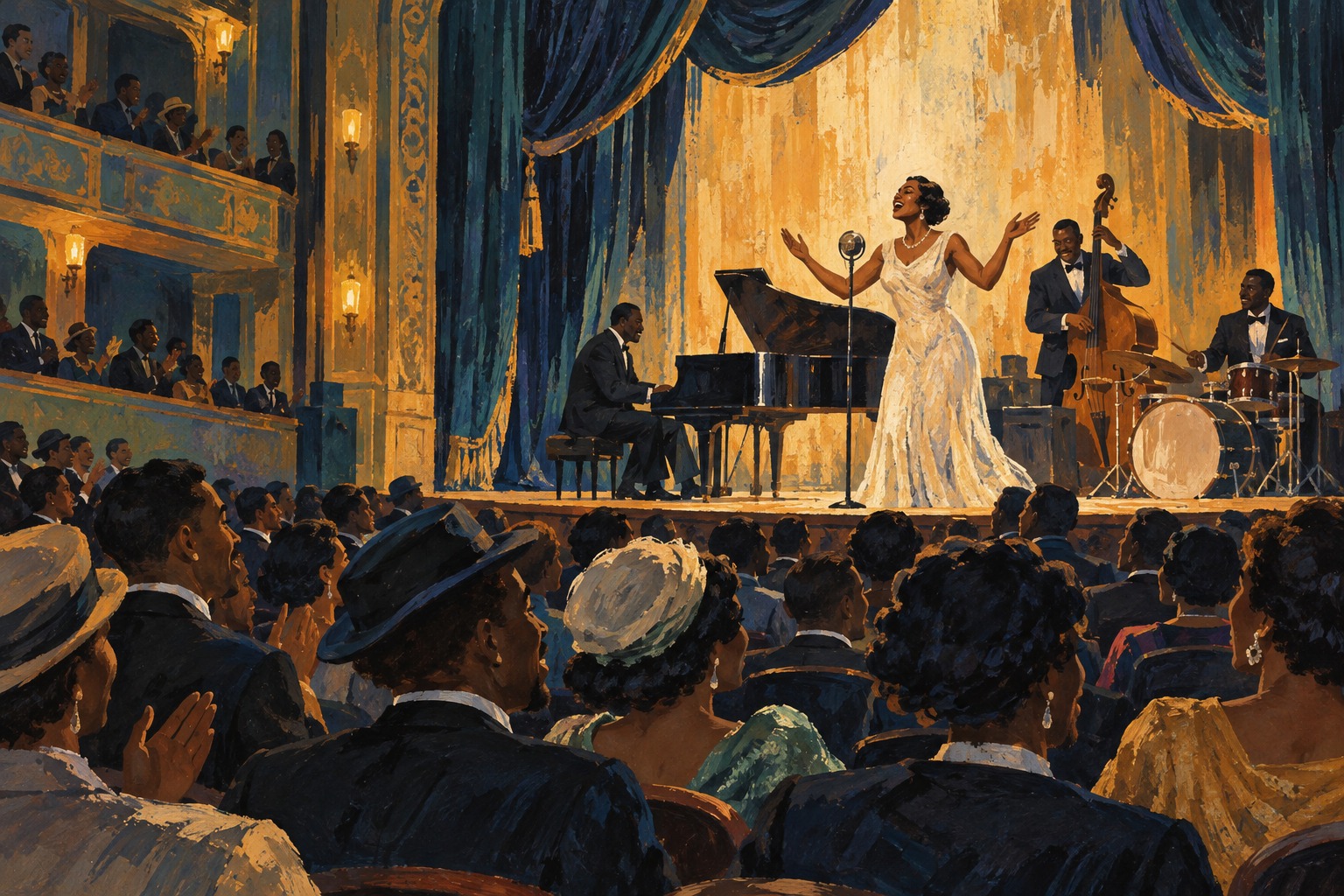
Lincoln Theatre
Interpretive artwork · a discussion prompt, not historical evidence or a literal reconstruction.
Meaning in brief
The poem presents theatre-going as a cultural experience shaped by performance and audience response. Public entertainment becomes a space for shared feeling and expression.
Look closely: Notice the relationship between stage and audience. The illustration imagines a performance space and does not identify an actual production.
Image → poem → analysis
Question: How does a shared performance connect private feeling with collective identity?
Compare a B2 analytical model
The theatre brings individual responses into a shared cultural space. Hughes’s attention to performance and audience experience helps show that identity is expressed through participation, sound and feeling, not only through statements about heritage. An analytical response should track whose perspective shapes the scene and explain how the poem’s language gives the performance emotional significance.
Evidence hunt: Find wording that conveys a response to the performance. Explain the tone or sound of that wording and its relationship to shared experience.
Check exact wording in your authorised copy. Explain a choice in the poem; colours and objects in this illustration are not Hughes’s techniques.
inequalitycommunityentertainmentBlack cultural life
Synopsis
The poem presents Black audiences enjoying music and entertainment in the Lincoln Theatre while the broader realities of labour and inequality remain outside. The symbolic presence of Lincoln evokes emancipation, creating irony when placed beside continuing racial and economic inequality.
1. Literal meaning
2. Symbolic Lincoln
3. Theatre vs labour
4. Synopsis writing
5. Best answer
Question: How does the theatre setting deepen ideas about inequality?
6. Independent response
How does Hughes use setting and contrast to represent Black cultural life?
Poem 7
Theme for English B
Interpretive artwork · a discussion prompt, not historical evidence or a literal reconstruction.
Meaning in brief
A student responds to a writing assignment by considering who he is and how his experience relates to his instructor’s. Identity becomes both personal and relational.
Look closely: The writing desk and city/classroom layers suggest the contexts that enter a personal response. They are symbolic rather than an exact reconstruction.
Image → poem → analysis
Question: Why might a supposedly simple writing task raise complex questions about identity?
Compare a B2 analytical model
Hughes turns the assignment into a negotiation over what counts as an authentic personal voice. The student’s reflection connects everyday preferences with differences in race, experience and authority, challenging the assumption that a page can emerge outside its social context. Yet the relationship with the instructor also suggests connection across difference, so an effective interpretation avoids treating identity as either complete sameness or absolute separation.
Evidence hunt: Find a short moment that links similarity and difference between student and instructor. Explain how the voice or structure complicates a simple opposition.
Check exact wording in your authorised copy. Explain a choice in the poem; colours and objects in this illustration are not Hughes’s techniques.
identityraceshared humanitypowereducation
Synopsis
A Black college student is asked to write a page that is “true” to himself. The apparently simple task becomes complicated because race, place, culture and the unequal relationship with his white instructor shape how he understands identity. The poem balances shared humanity with unequal social power.
Short evidence bank
“I wonder if it’s that simple?”“the only colored student”“part of you… part of me”“somewhat more free”
1. Literal meaning
2. Why “I wonder if it’s that simple?”
3. Shared humanity + unequal freedom
4. Synopsis writing
5. Best answer
Question: How does Hughes represent the complexity of identity?
6. Independent response
How does Hughes show that cultural identity is both personal and socially shaped?
Theme map across the seven poems
Theme
Best poems
Useful conceptual distinction
Cultural identity
Rivers; I, Too; Theme for English B
ancestry → national belonging → negotiated selfhood