Langston Hughes · Language, identity and culture
Poetry atlas
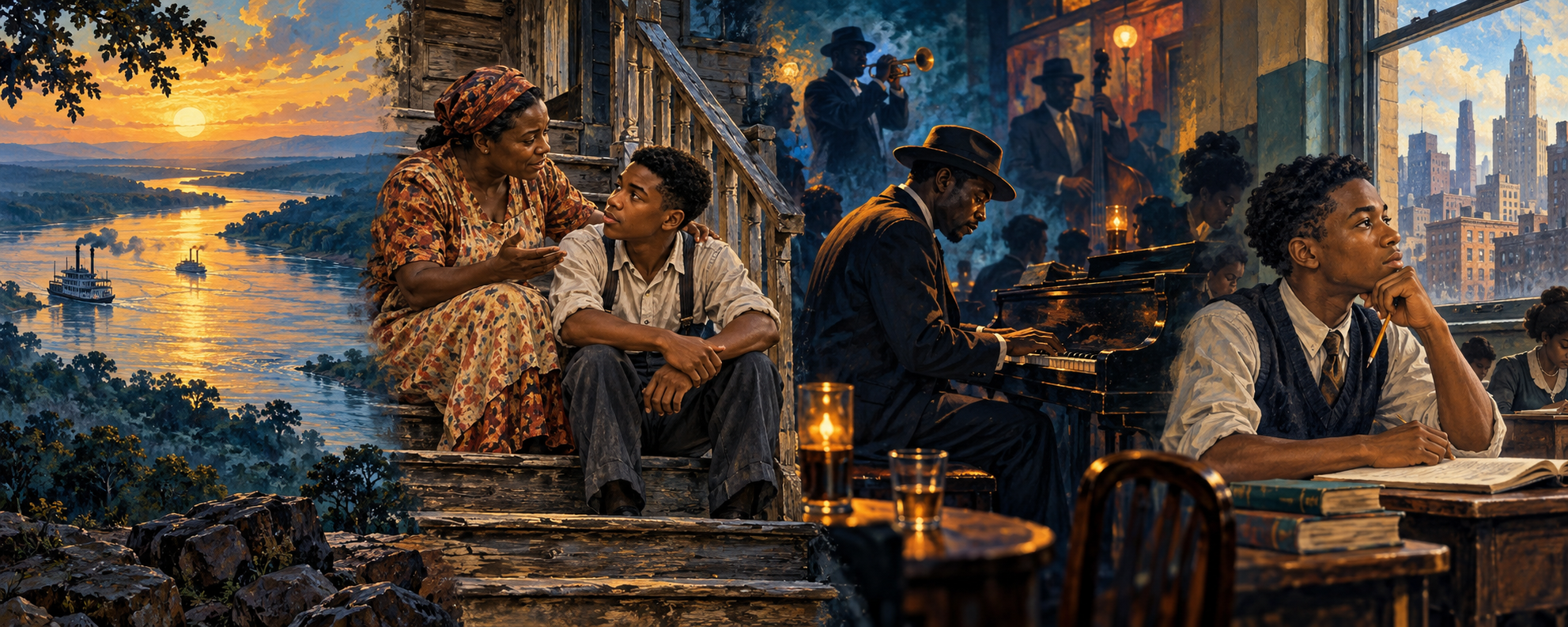
Visual workshop · sequence, challenge and map evidence
Find a theme, compare the ways two poems develop it, then build an argument using checked evidence.
Developed comparison models
Read the argument, then add a brief quotation from each poem and explain its precise wording. These models demonstrate reasoning; they are not complete examination responses.
Historical depth and future belonging
The Negro Speaks of Rivers and I, Too
Hughes represents cultural identity as both an inheritance and a claim to recognition. In The Negro Speaks of Rivers, the speaker links the self with rivers across civilisations, giving Black identity a historical depth that exceeds one individual life. By contrast, I, Too develops a future-facing voice: its movement from exclusion towards anticipated inclusion exposes the gap between national ideals and lived inequality. Both speakers resist marginalisation, but the first builds authority through historical continuity while the second challenges social boundaries through confident expectation. Together, the poems suggest that belonging depends on recognising both cultural history and the demand for change.
Trace the structure: shared claim → first method and effect → contrast → second method and effect → qualified judgement.
Your turn: Where would a quotation strengthen the argument? Which word or rhythmic choice would you analyse?
Personal counsel and artistic endurance
Mother to Son and The Weary Blues
Both poems connect resilience with hardship, yet Hughes avoids presenting endurance as effortless. In Mother to Son, the extended staircase metaphor turns struggle into a difficult but continuing movement, while the mother’s direct address gives survival the authority of lived experience. The Weary Blues instead represents a performer whose music makes suffering audible through rhythm and a changing relationship between performer and observer. Where the mother urges another person to continue, the musician expresses pain without a simple promise that it will disappear. This difference suggests that resilience can involve practical guidance as well as the cultural act of voicing difficulty.
Trace the structure: shared claim → first method and effect → contrast → second method and effect → qualified judgement.
Your turn: Where would a quotation strengthen the argument? Which word or rhythmic choice would you analyse?
Identity in conversation
Madam and the Phone Bill and Theme for English B
Hughes explores how people assert identity within unequal relationships. Madam and the Phone Bill uses conversational voice and comic resistance to give an ordinary speaker authority in a dispute. Theme for English B places a student’s self-definition within an educational task, using reflection to question how personal experience is shaped by race and shared social life. Both voices resist being reduced to an institution’s expectations, yet their methods differ: the first speaker negotiates through lively confrontation, while the second develops an argument about connection and difference. Their distinct forms show that cultural identity is expressed through everyday speech as well as reflective writing.
Trace the structure: shared claim → first method and effect → contrast → second method and effect → qualified judgement.
Your turn: Where would a quotation strengthen the argument? Which word or rhythmic choice would you analyse?
Compare two poetic voices
This work saves in this browser. Models are starting arguments; add checked evidence from both poems.